Helichrysum Oil for Skin: What Immortelle Can — and Can’t — Do
There are some plants you appreciate for what they do, and others you fall a little bit in love with.
Helichrysum is both.
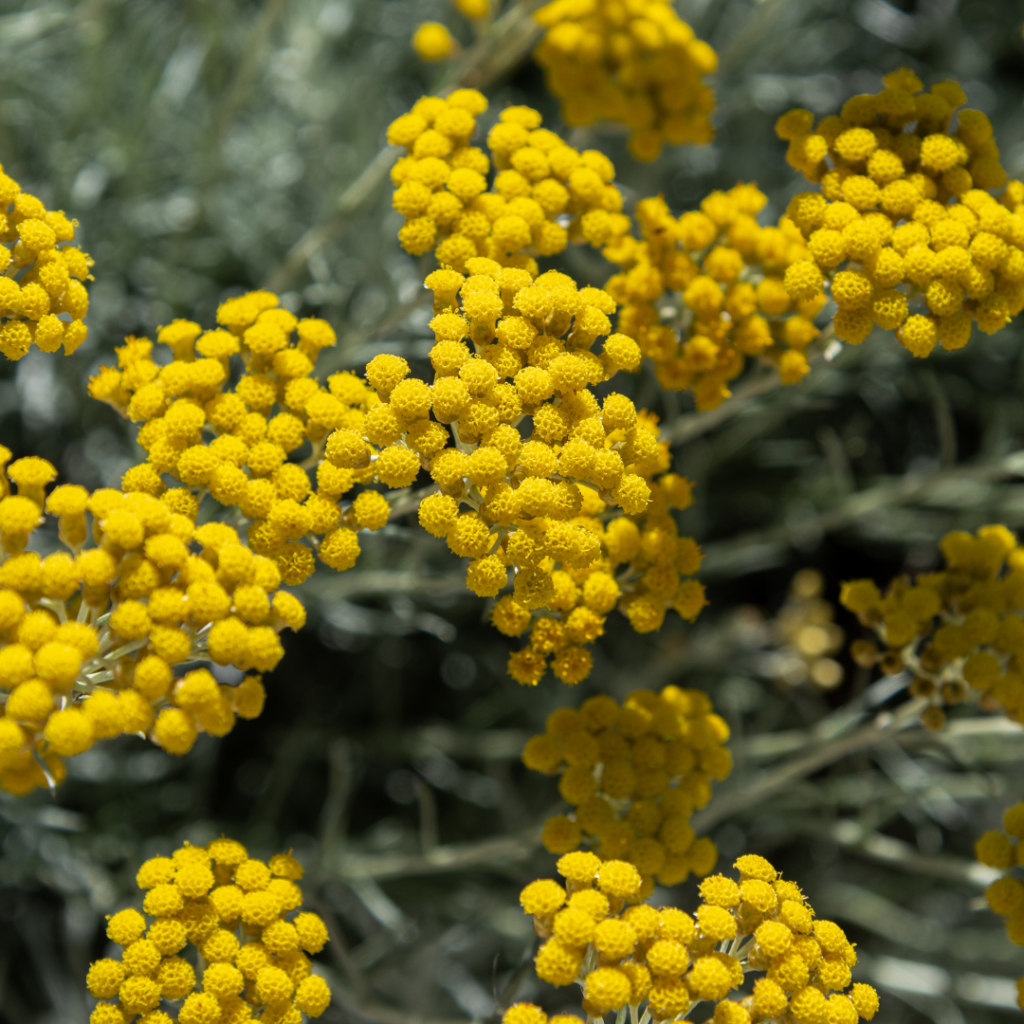
Also known as immortelle or everlasting, Helichrysum italicum is a small Mediterranean plant with silvery leaves and clusters of intensely golden flowers. The flowers retain their color beautifully after drying, helping explain the romantic “everlasting” nickname.
Its aroma is just as distinctive. To me, helichrysum smells a bit like honey warmed by sunshine, with notes of apple and wood—warm, herbaceous, slightly sweet, and difficult to compare to anything else.
It is also one of those botanicals that has accumulated an almost mythical reputation in skincare.
Search online and you may see helichrysum described as everything from a scar eraser to “nature’s Botox.”
As an herbalist and esthetician, I think the truth is more interesting.
Helichrysum does have some genuinely compelling skin science behind it. But understanding what it can realistically do requires distinguishing traditional use from clinical evidence—and essential oil from botanical extract.
What Is Helichrysum?
Helichrysum italicum belongs to the Asteraceae, or daisy, family and grows naturally throughout parts of the Mediterranean.
The botanical name Helichrysum is associated with the Greek words for sun and gold, an appropriate description of its brilliant yellow blossoms.
Immortelle has a long history in European herbal traditions, including use for irritated skin, bruising, wounds, and inflammation. Modern laboratory research has identified antioxidant, anti-inflammatory, and antimicrobial activity in various extracts and constituents of the plant.
That history is interesting—but traditional use and modern evidence are not the same thing. This is where helichrysum deserves a little nuance.
Helichrysum Essential Oil vs. Helichrysum Extract
This distinction matters.
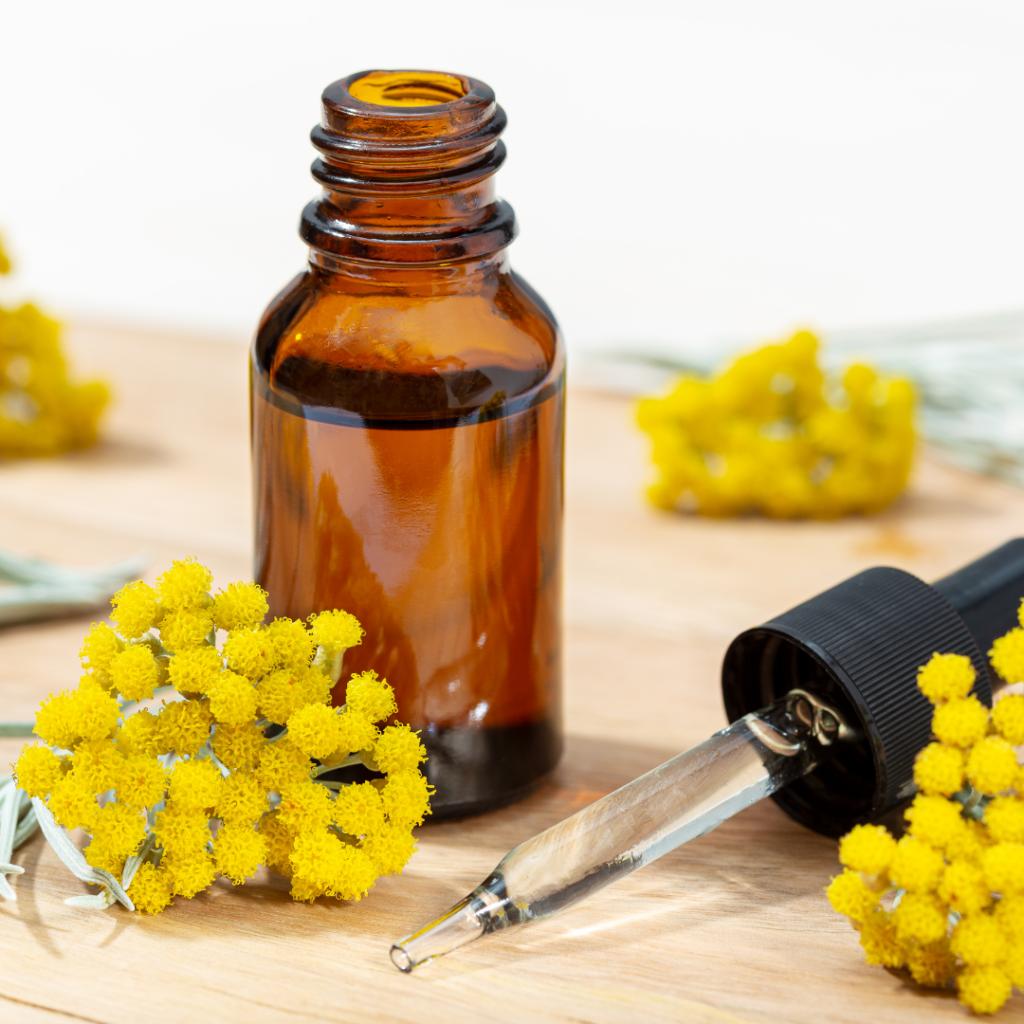
When you see Helichrysum italicum essential oil, you are looking at the volatile aromatic portion of the plant, usually obtained through steam or hydrodistillation.
Depending on where the plant was grown and how it was distilled, the essential oil may contain varying proportions of compounds such as neryl acetate, alpha-pinene, gamma-curcumene, nerol, and other terpenes.
A Helichrysum italicum extract, on the other hand, may be produced using water, alcohol, glycerin, carbon dioxide, or other extraction methods. These techniques can capture very different compounds, including flavonoids, phenolic acids, and compounds such as arzanol that are not present in the same way in the essential oil.
In other words:
Helichrysum essential oil and helichrysum extract come from the same plant, but they are not interchangeable ingredients.
That becomes particularly important when we look at the research.
Why Is Helichrysum Used in Skincare?
Traditionally, helichrysum has been especially associated with skin that appears:
- bruised or swollen
- irritated or inflamed
- environmentally stressed
- delicate or reactive
- in need of recovery support
Its appeal in modern cosmetic formulations is largely related to its antioxidant and soothing plant chemistry.
Laboratory studies have identified anti-inflammatory and antioxidant activity in H. italicum preparations, while newer skin-model research suggests certain extracts and essential-oil constituents may influence pathways involved in epidermal differentiation and barrier formation.
That is promising.
It is not the same as saying that rubbing helichrysum essential oil on your face will “regenerate” your skin.
Botanical science is rarely that simple.
What Does the Research Say About Helichrysum and the Skin?
This is where things get genuinely interesting.
Helichrysum and irritated skin
A study using a supercritical H. italicum extract on artificially irritated human skin found evidence of skin-protective and soothing activity. The researchers themselves noted that human clinical evidence for topical helichrysum had previously been limited, which is an important reminder that much of the plant’s reputation historically came before good human trials.
There is also human research involving finished skincare products containing helichrysum extract.
In one clinical study, a night cream containing H. italicum extract along with ingredients including melatonin, carnosine, niacinamide, and hyaluronic acid improved hydration and transepidermal water loss and reduced experimentally induced stinging. Participants also showed improvements in wrinkles and visible pigmentation over time.
But here is the part marketing copy often leaves out:
That was a multi-ingredient cream.
We cannot reasonably assign every result to helichrysum alone.
Still, the findings support the idea that H. italicum can be a useful part of a well-designed skin-calming formula.
What About the Skin Barrier?
This may be one of the most intriguing newer areas of helichrysum research.
Researchers studying a Corsican Helichrysum italicum essential oil found that neryl acetate, one of its major aromatic constituents, influenced genes and proteins involved in epidermal differentiation, lipid production, ceramide synthesis, and formation of the skin barrier in human skin models.
After several days of exposure, increases in skin lipids and ceramides were also observed.
That does not mean helichrysum essential oil is a replacement for ceramides or a barrier-repair moisturizer.
But it does give us a fascinating possible explanation for why this plant has historically been associated with stressed skin.
This is the kind of botanical science I love: sometimes modern research begins to illuminate observations herbalists have been making for generations.
Is Helichrysum an Anti-Aging Ingredient?
Possibly—but I would use that phrase carefully.
Some laboratory studies have found antioxidant activity and effects on enzymes involved in collagen and elastin breakdown.
More interestingly, a 2026 study investigated a very specific supercritical CO₂ extract of Helichrysum italicum.
Researchers compared a cream containing 0.1% of this extract with a cream containing 0.1% retinol. Forty-seven women completed both treatment periods.
After 28 days, the helichrysum-extract formulation produced improvements in wrinkles of a magnitude similar to those seen with the retinol formula under those particular study conditions, while causing less reported irritation. Skin-model testing also suggested effects on pathways involved in epidermal renewal, barrier support, and collagen-related processes.
That is very interesting.
It is also very new research, and it involves a patented/specialized extract—not ordinary helichrysum essential oil.
So I would not call helichrysum “natural retinol.”
Not yet.
And possibly not ever.
What the study does tell us is that Helichrysum italicum contains botanical chemistry worthy of much more investigation.
Can Helichrysum Increase Collagen?
This is another place where wording matters.
Laboratory and skin-model research has shown activity involving collagen-related pathways, and the newer CO₂-extract study found increases in several types of collagen in reconstructed skin models.
That is encouraging.
But saying “helichrysum boosts collagen” as a blanket statement goes further than the evidence allows.
The effect depends on the type of extract, concentration, formulation, and method of study.
A bottle of essential oil and a standardized cosmetic extract are not biologically identical simply because the label says Helichrysum italicum.
Does Helichrysum Help Scars or Bruising?
This is probably one of helichrysum’s best-known traditional uses.
It has long been used in herbal and aromatherapy traditions for bruising, swelling, and traumatized tissue.
There is some published clinical observation involving postoperative patients, but the protocol included both oral and topical helichrysum essential oil, which makes it impossible to know how much of the reported improvement came specifically from topical use.
So while I think its historical use for bruised or stressed-looking skin is reasonable to acknowledge, I would not call helichrysum a proven scar treatment.
For established scars, we have much stronger evidence for things like silicone therapy, sun protection, retinoids in appropriate situations, and procedures designed specifically for scar remodeling.
Helichrysum may be a beautiful supporting botanical.
That is different from being a scar eraser.
What About Dark Spots?
This is another claim I would soften considerably.
Helichrysum has antioxidant and anti-inflammatory activity, and reducing ongoing inflammation can certainly matter for skin prone to uneven tone.
But I do not consider helichrysum a primary pigment-correcting ingredient.
For stubborn hyperpigmentation, ingredients such as vitamin C, retinoids, azelaic acid, niacinamide, certain acids, and—most importantly—daily sun protection have much stronger supporting evidence.
Helichrysum can play a supporting role.
It does not need to be the hero of every story.
Is Helichrysum Good for Sensitive Skin?
Sometimes.
This is where “natural” can become misleading.
Helichrysum extracts may be very soothing in appropriately formulated products. Essential oil, however, is a concentrated aromatic substance.
Like other essential oils, helichrysum can potentially cause irritation or allergic contact dermatitis in susceptible individuals. Cases of contact allergy to helichrysum-containing aromatic materials have been documented.
That does not make helichrysum essential oil a “bad” ingredient.
It simply means formulation matters.
For highly reactive skin, rosacea-prone skin, or anyone with known fragrance sensitivities, I would generally prefer a carefully formulated product rather than applying undiluted essential oil directly to the skin.
And please: do not apply neat essential oils to your face because someone on the internet told you to.
Your skin has enough to deal with.
How I Think About Helichrysum After Nearly 30 Years in Skincare
I don’t think of helichrysum as a miracle anti-aging ingredient.
I think of it as something subtler—and honestly, more interesting.
It is a beautiful botanical for formulas designed around comfort, recovery, resilience, and stressed-looking skin.
Its traditional use makes sense alongside what we’re beginning to understand about its antioxidant chemistry, inflammatory pathways, and possible relationship with epidermal barrier function.
And then there is the sensory experience.
That remarkable aroma—warm honey, sun-warmed herbs, a little apple, a little wood—creates an aromatic pause that is difficult to separate from the experience of using it.
Skincare is chemistry.
But it is also touch, scent, ritual, nervous-system input, and the simple act of paying attention to your own skin for a few minutes.
There is room for both.
So, Is Helichrysum Worth the Hype?
Some of it.
Helichrysum is not Botox in a flower.
It is not a proven scar eraser.
It will not magically remove pigmentation or rebuild all the collagen you’ve lost since 1997.
And frankly, plants do not need superhero marketing to be worthwhile.
Helichrysum italicum is a fascinating Mediterranean botanical with a long history of traditional use, intriguing antioxidant and soothing chemistry, emerging research around barrier support, and some promising early clinical data.
That is already plenty impressive.
Sometimes the most respectful way to talk about a plant is not to make it miraculous.
It is simply to tell the truth about how remarkable it already is.