
Hormonal Acne and DHT: Why the Same Chin Breakout Keeps Coming Back
Hormonal acne is often explained in dramatic terms.
PCOS. Major hormone imbalance. High testosterone. Abnormal labs. Prescription medication.
And yes — for some people, acne is connected to PCOS or another endocrine pattern. That matters, and it deserves medical attention.
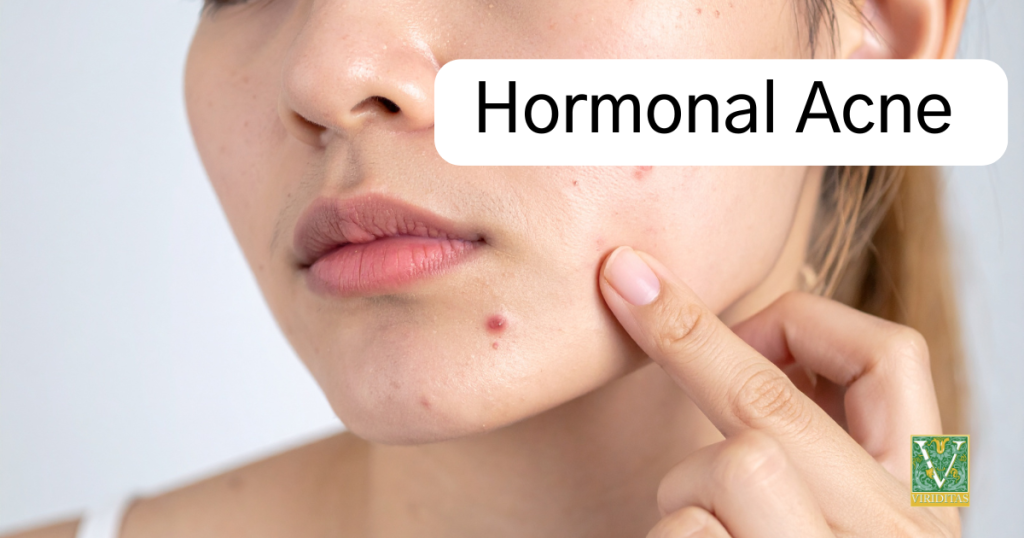
But in the treatment room, we often see something much more common:
The once-a-month chin breakout.
The tender bump that appears in nearly the same place every cycle.
The deep lesion that shows up before a period.
The pore that seems to clear, then refill.
The same little neighborhood of skin that becomes inflamed again and again.
This kind of hormonal acne can be incredibly frustrating because it feels predictable and mysterious at the same time. You know where it is going to happen. You may even know when it is going to happen. But stopping the cycle is another story.
At Viriditas, we do not see this as random bad luck.
We see it as a repeating pattern inside the follicle.
Hormonal Acne Is Not Always a Major Hormone Disorder
When people hear “hormonal acne,” they often assume something is terribly wrong with their hormones.
That is not always true.
Sometimes hormonal acne is connected to PCOS, irregular cycles, unwanted facial hair, hair thinning, or other signs that deserve medical evaluation. But many people with cyclical acne have regular periods, normal labs, and no diagnosed hormonal disorder.
Their skin simply reacts strongly to the normal hormonal shifts of the menstrual cycle.
Adult female acne commonly worsens before menstruation, and hormonal therapies may be considered when acne has a premenstrual pattern, severe oiliness, or lower-face distribution.
In simpler terms:
Your hormones may be moving in a normal rhythm, but your oil glands may be highly sensitive to the signal.
That sensitivity is where DHT enters the conversation.
DHT, 5-Alpha Reductase, and the Oil Signal
Testosterone can be converted in the skin into DHT, or dihydrotestosterone, by an enzyme called 5-alpha reductase.
DHT is a stronger androgen signal. Androgens influence sebaceous glands, the tiny oil-producing glands inside the pores. When those glands are sensitive to androgen signaling, they may produce more sebum.
Sebum is not bad. Your skin needs oil.
But in acne-prone skin, excess oil can become fuel.
More oil inside a pore that is already inflamed, congested, or slow to clear can create the perfect conditions for acne to repeat: more sebum, more sticky buildup, more bacterial activity, and more inflammation.
This is why hormonal acne is not just a “period problem.”
It is a pore-environment problem.
The Monthly Chin Breakout: A Familiar Pattern
A very common pattern we see is the monthly breakout on the chin or lower face.
Often, it appears in the same area each cycle. In facial reflexology traditions, the chin is associated with the reproductive system and ovaries. That does not mean every chin breakout is literally an ovary problem, but clinically, we do often see chin acne behave cyclically.
The pattern may look like this:
A hormonal shift occurs.
The oil gland gets stimulated.
Sebum production increases.
The pore becomes more crowded.
Bacteria respond to the richer environment.
Inflammation rises.
A tender breakout forms.
Then it heals — mostly.
But not always completely.
And that is where the long-term pattern becomes important.
When the Same Pore Keeps Getting Inflamed
A follicle is not an empty hole in the skin. It is living tissue.
When the same follicle becomes inflamed again and again, the surrounding structure can become irritated, stretched, thickened, or distorted over time. This is especially true when lesions are deep, picked, squeezed, slow to heal, or repeatedly inflamed in the same spot.
Clinically, these pores can begin to look different.
They may appear stretched, twisted, scarred, or more difficult to clear. These pores may hold debris deeper in the follicle. They may seem to refill quickly after extraction and become “hiding places” where congestion and bacteria are harder to reach.
This is one reason recurring hormonal acne can feel so stubborn.
The problem is not only the hormonal surge.
It is the fact that the follicle has become a familiar little hiding place for the acne pattern.
The Buffet, the Neighborhood, and the Traffic Jam
Think of the pore as a tiny neighborhood.
When the skin is calm, the neighborhood has flow. Oil moves. Cells shed. Bacteria live quietly as part of the local ecosystem.
But during a hormonal shift, the oil gland may suddenly start producing more sebum.
Now there is more food at the buffet.
If the follicle is already stretched, scarred, twisted, or congested, that extra oil does not move through easily. It pools. It mixes with sticky dead skin cells. The traffic backs up.
Bacteria are already present in the skin. They are not evil invaders. But when the pore becomes oily, crowded, and low-flow, they enjoy the feast. They respond to the environment. Their chemical signaling can become louder. The immune system notices.
The campfire gets fuel.
The neighborhood gets noisy.
The traffic jam becomes inflamed.
And the same breakout returns.
This is why clear skin is not just about drying up oil or killing bacteria.
Clear skin happens when we reduce the signals, fuel, congestion, and inflammation that keep acne repeating.
Why This Kind of Acne Can Be Hard to Reach
Deep, recurring hormonal acne is often harder to clear because the follicle itself may not be functioning smoothly.
If the pore is narrow, twisted, scarred, or chronically congested, ingredients may not reach the deepest part of the problem easily. Extractions may help, but the follicle may refill if the underlying oil signal and inflammatory pattern are still active.
This is where a more strategic approach matters.
We have to think beyond the breakout we can see.
We need to ask:
- What is signaling this pore?
- What is feeding it?
- What is blocking flow?
- What is keeping inflammation active?
- What has this follicle learned to repeat?
That is a very different question from, “What can I put on this zit?”
Retinoids: Keeping the Road Open
You’ve probably heard Retinoids described as “cell turnover” ingredients, but that undersells them.
In acne-prone skin, retinoids help normalize the way cells behave inside the follicle. They reduce the sticky buildup that becomes the beginning of clogged pores, help prevent microcomedones, and support smoother follicular flow. Current acne guidelines strongly recommend topical retinoids for acne because they help unclog pores and reduce inflammation.
For hormonal acne, this matters because the monthly oil surge is only one part of the problem.
If the pore is already narrow, sticky, scarred, inflamed, or slow to clear, that extra sebum has nowhere to go. It becomes fuel inside a traffic jam.
Retinoids do not block testosterone, DHT, or androgen receptors directly. That is the territory of medications like spironolactone or clascoterone/Winlevi, and certain 5-alpha reductase–focused strategies. But retinoids can help make the follicle less vulnerable to the effects of that hormonal surge by improving flow, reducing congestion, and calming some of the inflammatory behavior that keeps acne repeating.
In simpler terms:
Anti-androgen support helps turn down the oil signal.
Retinoids help keep the road open.
Retinoids are not always the first step for every skin, every season, or every barrier. In our acne work, we introduce them carefully and only when the skin is ready.
Blocking the Signal: Anti-Androgen Support
For this kind of acne, reducing the androgen signal can be helpful.
That may include medical prescriptions, topical anti-androgen support, herbal conversations, and nutritional strategies. The goal is not to shut the skin down. The goal is to reduce the oil-triggering signal so the follicle is not flooded every month.
Winlevi / Clascoterone
Winlevi is a prescription topical acne medication. Its active ingredient is clascoterone, an androgen receptor inhibitor indicated for acne vulgaris in patients 12 and older.
It works locally in the skin by targeting androgen receptor activity. This makes it especially interesting for acne patterns where androgen signaling, oil production, and inflammation are part of the cycle. Reviews describe clascoterone as a topical androgen receptor inhibitor that competes with DHT at androgen receptors in the skin.
This does not mean it replaces topical acne care. It may help turn down the signal, but the follicle may still need help clearing congestion, calming inflammation, and restoring flow.
Topical Spironolactone
Topical spironolactone is different from Winlevi. Winlevi is clascoterone, not spironolactone.
Topical spironolactone may be available through some compounding pharmacies or specific prescribing platforms, but it is a more specialized conversation with a medical provider.
Oral Spironolactone
Oral spironolactone is often used for hormonal-pattern acne in some people. It can reduce androgen effects on oil production, but it requires medical supervision and is not appropriate for everyone. Current acne guidelines include spironolactone among systemic treatment options for acne management.
A simple way to think about anti-androgen support:
It may help turn down the monthly oil signal, but we still have to clean up the traffic jam.
Herbal and Nutritional Support for the Monthly Pattern
This is where the conversation becomes more nuanced.
Not every cyclical breakout needs prescription medication. And not every herbal or dietary strategy is strong enough on its own. But for some clients, gentle internal support may help reduce the intensity of the monthly flare.
Spearmint Tea
Spearmint is often discussed for androgen-influenced patterns. Some research has explored spearmint tea in relation to androgen-related symptoms such as hirsutism, but this is not the same as proving it treats acne directly. It is best framed as gentle hormonal-pattern support, not as “natural spironolactone.”
A cup of spearmint tea can become a daily aromatic pause: cooling, simple, and quietly supportive.
Saw Palmetto
Saw palmetto is often discussed as a 5-alpha reductase–influencing herb. The acne-specific evidence is limited, but it may be relevant in androgen-pattern conversations.
It should be used thoughtfully, especially with medications, pregnancy considerations, hormone-sensitive conditions, or medical complexity.
Seed Cycling
Seed cycling is another interesting, gentle strategy some clients explore. It usually involves rotating seeds such as flax and pumpkin during one phase of the cycle, then sesame and sunflower during another.
The idea is to support hormonal rhythm and fatty acid balance across the menstrual cycle.
Seed cycling is not a guaranteed acne treatment. But for some clients, it can be a food-based ritual that supports menstrual rhythm, mineral intake, fiber, and fatty acid diversity — all of which may matter in the larger acne terrain.
Clients often ask about supplements for hormonal acne, especially DIM, inositol, and sulforaphane.
What About DIM, Inositol, and Sulforaphane for Acne?
These can be worth discussing, but they are not interchangeable. Each one speaks to a different part of the acne terrain.
DIM, or diindolylmethane, is associated with cruciferous vegetables like broccoli, cauliflower, Brussels sprouts, and kale. It is often marketed for “hormonal acne” because of its relationship to estrogen metabolism, but the evidence for acne is still limited. It may be more relevant when the pattern suggests estrogen metabolism support, PMS-type symptoms, or broader hormonal concerns.
Inositol is most relevant when acne has a blood sugar, insulin, PCOS, or androgen-pattern component. It is not “for every hormonal breakout,” but it may be helpful when there are signs of insulin resistance, irregular cycles, cravings, energy crashes, or PCOS-type symptoms.
Sulforaphane is a compound found in cruciferous vegetables, especially broccoli sprouts. It is not a classic “hormonal acne” supplement, but it is interesting because of its relationship to antioxidant defense, inflammatory pathways, and cellular stress response. For acne-prone skin that looks hot, inflamed, and slow to heal, sulfur-rich foods and cruciferous support may be part of the bigger picture.
The important thing is not to take every supplement that has ever been mentioned for acne.
The better question is:
What pattern are we trying to support?
- If the pattern looks androgen-driven, we may think about androgen signaling.
- If it looks blood-sugar driven, we may think about inositol and meal steadiness.
- If it looks hot, inflamed, and slow to heal, we may think about omega-3s, zinc, vitamin C or sulfur-rich foods.
- If it looks cyclical and predictable, we may think about menstrual rhythm, fatty acid balance, and the monthly oil surge.
Supplements can be helpful, but they are not substitutes for a clear topical plan, professional guidance, or medical care when symptoms suggest a deeper hormonal condition.
We’ll explore this more deeply in a separate guide to supplements for hormonal acne.
Why Skincare Still Matters
Even when hormonal support is helpful, the skin still needs topical care.
If a follicle has become stretched, twisted, congested, or inflamed, we cannot only work from the inside. The pore needs direct support.
That may include:
- Benzoyl peroxide when pustular activity is present
- Mandelic or lactic acid to support smoother follicular shedding
- Professional extractions when appropriate
- LED therapy to support inflammation and healing
- Barrier support so the skin can tolerate acne correction
- SPF to reduce post-inflammatory pigmentation
- Consistent homecare adjustments over time
The goal is not to blast the skin.
The goal is to restore flow.
We want to loosen what is stuck, reduce what is feeding the pattern, calm what is inflamed, and prevent the same pore from becoming the monthly meeting place for acne again.
What Makes This Different from Standard Hormonal Acne Advice
Standard advice often says:
“Take spironolactone.”
“Go on birth control.”
“Use a retinoid.”
“Try spearmint tea.”
“Cut dairy.”
“Manage stress.”
Some of those things may help.
But the more important question is:
Why does the same follicle keep participating?
At Viriditas, we look at the recurring acne site itself.
- Is the follicle damaged, stretched, scarred, congested, or inflamed?
- What about the timing of the flare?
- Is there excessive oil production?
- How is the barrier?
- What can the skin tolerate?
Because recurring hormonal acne is not just a hormone story.
It is also a follicle story.
The Viriditas View
That monthly chin breakout is not meaningless.
It may be a visible sign of a repeating conversation between hormones, oil glands, bacteria, inflammation, and a follicle that has become easier for acne to revisit.
The work is to interrupt the pattern from more than one direction.
- Quiet the signal.
- Reduce the fuel.
- Clear the congestion.
- Calm the fire.
- Restore flow.
This is how we approach hormonal acne: not as a battle against the skin, but as a process of changing the conditions that keep acne returning.
Your skin does not need a war.
It needs a better map. Contact us when you’re ready for help.
[…] Was there a hormonal change? […]