How to Stop Wasting Money on Skincare: 15 Tips From an Esthetician
Originally published in 2015. Thoroughly updated in 2026.

Skincare has become considerably more complicated—and considerably more expensive—since I first wrote this article more than a decade ago.
We now have ten-step rituals, weekly product launches, overflowing influencer shelves, and algorithms that can convince you your perfectly normal skin needs six new serums before breakfast.
It probably does not.
After nearly 30 years as a licensed esthetician, I can tell you that most people do not need more skincare. They need fewer products, chosen with greater intention, used correctly, and given enough time to work.
Wasting money on skincare is not only about paying too much for a product. It also happens when you:
- Buy several products that do essentially the same thing
- Choose products without considering your skin type or condition
- Use more than your skin needs
- Abandon a product before it has had time to work
- Combine too many active ingredients
- Damage your skin barrier and then purchase three more products to repair it
Your skin does not need a twelve-step group project.
It needs a thoughtful plan.
Here are 15 ways to make your skincare products—and your skincare budget—work harder for you.
1. Know What the Product Is Supposed to Do
Before buying a product, ask one very simple question:
What specific job will this perform in my skincare ritual?
“Glow” is not a job.
Neither are “detox,” “poreless,” “ageless,” or “glass skin.” These are marketing ideas, not meaningful descriptions of what a formula does.
A product should have a clear purpose. Perhaps it:
- Removes makeup and sunscreen
- Cleanses without disrupting the skin barrier
- Supports hydration
- Treats acne
- Softens rough texture
- Helps improve uneven pigmentation
- Provides antioxidant support
- Protects the skin from ultraviolet exposure
When every product has a defined purpose, it becomes easier to recognize duplicates—and considerably harder for an attractive bottle to talk its way into your shopping cart.
Before purchasing something new, look at what you already own. You may discover that your cabinet contains three exfoliating serums, four moisturizers, and enough niacinamide to supply a small village.
2. Stop Buying Skincare for the Skin You Wish You Had
Choose products for the skin that is actually on your face today.
Not the skin you had ten years ago.
Not your friend’s skin.
Not the influencer’s skin under professional lighting.
And certainly not the computer-generated poreless face floating through your social media feed.
Your skin may be oily but dehydrated. Acne-prone and sensitive. Mature and still prone to congestion. Dry in winter and balanced in summer. It may also change in response to hormones, medication, illness, stress, weather, travel, or an overenthusiastic evening with an exfoliating peel.
Skin is alive. It is responsive. Its needs are not carved into stone.
Buying according to a generic label such as “anti-aging,” “clean beauty,” or “for all skin types” is rarely enough. Look at the full formula, its intended function, and how it fits into everything else you use.
A wonderful product can still be completely wrong for your skin.
3. Use the Correct Amount
Using twice as much product rarely produces results twice as quickly.
It usually produces one of three things:
- Wasted product
- Irritated skin
- Little rolled-up bits of serum collecting along your jawline
More is not always more. Sometimes more is simply expensive residue on your pillowcase.
Follow the manufacturer’s directions when they are provided. As a general guide, many concentrated serums require only a few drops. A moisturizer should create a comfortable, even layer without leaving the skin heavily coated. Strong active products often require less than people expect.
Sunscreen is the important exception to excessive minimalism. Most people use too little, which reduces the protection they receive. Apply a generous, even layer to exposed skin and reapply according to your exposure and the product directions.
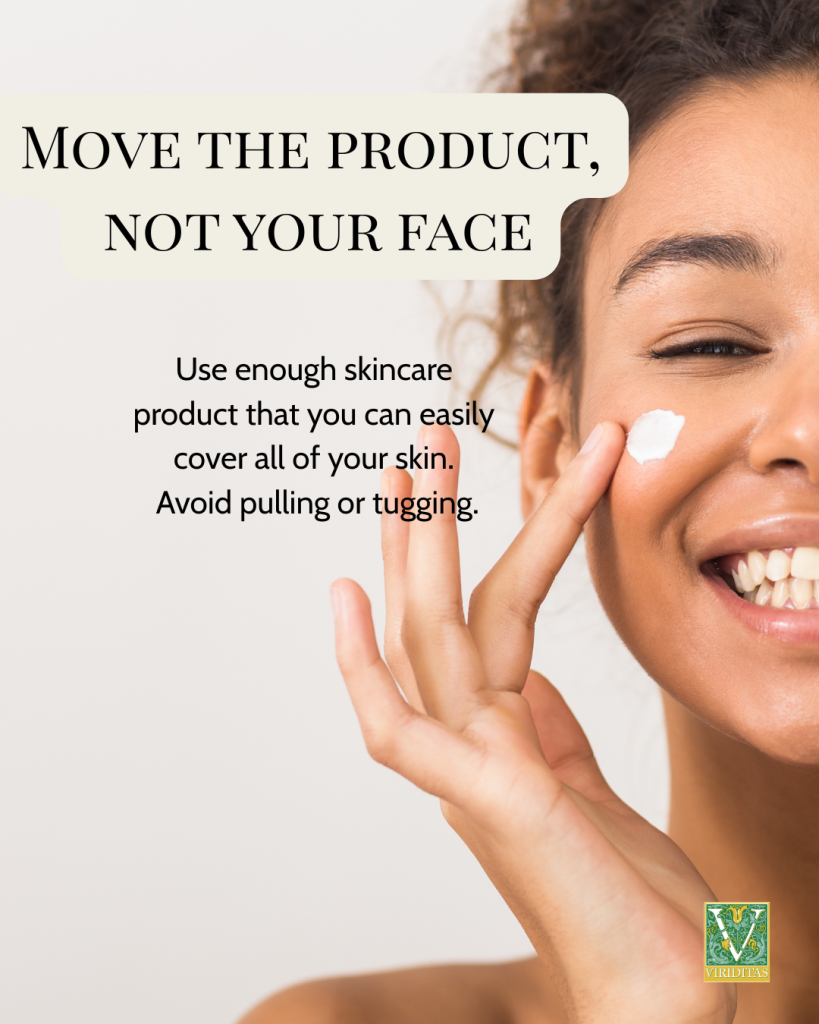
4. Move the Product, Not Your Face
This was one of my original tips, and I stand by it.
When applying a serum, cream, or eye product, glide or press the product across the skin rather than dragging your skin along with your fingers.
Move the product, not your face.
If your skin is pulling, stretching, or folding beneath your hands, consider what may be happening:
- You may not be using enough product.
- Your skin may be too dry during application.
- The texture may not suit that step of your ritual.
- You may simply need to slow down and use a lighter touch.
Skincare application does not need to become a vigorous facial workout. Use enough slip to distribute the product comfortably, then allow the formula to settle into the skin.
Around the eyes, use particularly gentle pressure. That delicate area does not need to be stretched into submission.
5. Apply Hydrating Products to Slightly Damp Skin
A dry sponge does not absorb water as readily as one that is already slightly damp. Skin is not literally a kitchen sponge, of course, but the image remains useful.
After cleansing, gently pat the skin so it is no longer dripping but still retains a little moisture. Then apply hydrating toners, essences, humectant serums, or moisturizer.
This can help the product spread more evenly, which means you may need less of it. Moisturizer then helps hold some of that water against the skin.
However, this does not mean every active product should be applied to damp skin.
Retinoids, exfoliating acids, benzoyl peroxide, and some prescription treatments may feel considerably more irritating when applied to wet or damp skin. Follow the directions for the specific formula and the guidance of your skincare professional or medical provider.
Hydration benefits from water. Strong actives may benefit from a little distance.
6. Cleanse Thoroughly—But Gently
A cleanser should remove what does not belong without stripping away everything that does.
At the end of the day, cleansing helps remove sunscreen, makeup, excess oil, pollution, sweat, and the general accumulation of living a human life.

However, cleansing should not leave your face feeling tight, squeaky, polished, or newly refinished.
That “squeaky-clean” feeling is not necessarily evidence of superior hygiene. It may be your skin barrier quietly filing a complaint.
Use lukewarm water rather than very hot water. Massage the cleanser gently over the entire face, remembering commonly neglected areas such as:
- The hairline
- Around the nose
- Beneath the lower lip
- The jaw
- The sides of the face
- The area near the ears
Rinse thoroughly. Cleanser left behind can contribute to irritation.
Most water-based cleansers do not need to remain on the skin for several minutes. Follow the product directions and focus on complete, gentle coverage rather than prolonged rubbing. Dermatology guidance consistently favors mild, non-abrasive cleansing, particularly for acne-prone, dry, reactive, or rosacea-prone skin.
7. Stop Treating Exfoliation Like a Moral Obligation
You do not receive bonus points for removing the greatest possible number of skin cells before bedtime.
Exfoliation can be useful. It may help improve rough texture, surface dullness, clogged pores, or uneven pigmentation when the exfoliant is appropriate for your skin.
But exfoliation is not automatically necessary every day—or even every week.
Your ideal frequency may be:
- Once or twice a week
- Every other week
- Seasonally
- Temporarily discontinued
- Not at all while the barrier recovers
The answer depends on your skin, the formula, the strength of the product, and the other active ingredients in your ritual.
Scrubs, brushes, cleansing tools, acid toners, exfoliating masks, retinoids, and acne treatments can all contribute to the skin’s total stimulation load. Your skin does not care that these products came from different brands. It experiences all of them together.
Mechanical exfoliation can be especially irritating for dry, sensitive, inflamed, or acne-prone skin.
Persistent burning, stinging, redness, flaking, tenderness, or sudden sensitivity may not mean that your products are “working.”
It may mean your skin would like you to stop.
8. Do Not Accidentally Duplicate Your Active Ingredients
This is one of the most common and expensive problems I see.
A person may use:
- An exfoliating cleanser
- An acid toner
- A brightening serum with another acid
- Retinol at night
- An exfoliating mask twice a week
- A peel pad whenever the skin looks “dull”
Individually, each product may be perfectly respectable.
Together, they may form a tiny angry committee dedicated to dismantling the skin barrier.
Read the ingredient lists and understand which products contain active ingredients such as:
- Glycolic, lactic, mandelic, or salicylic acid
- Retinol or other retinoids
- Benzoyl peroxide
- Vitamin C
- Niacinamide
- Enzymes
- Pigment-correcting ingredients
Duplication is not always harmful. Two products may contain the same supportive ingredient at low levels without causing a problem. But stacking multiple strong treatments without a plan can create irritation while producing no additional benefit.
Even masks can duplicate ingredients already present in a daily ritual, increasing dryness or irritation.
Know what each active is doing, how often you are using it, and whether your skin truly needs another version.
9. Introduce One New Product at a Time
When you begin three new products on the same evening, you lose the ability to tell which one:
- Helped
- Did nothing
- Caused irritation
- Triggered congestion
- Made your face itch at 2:00 a.m.
Introduce one product at a time whenever possible. Give your skin an appropriate observation period before adding the next one.
For reactive skin, patch testing a product first can be helpful. The American Academy of Dermatology recommends testing a new leave-on product on a small area twice daily for seven to ten days before broader use.
A patch test cannot predict every possible breakout or delayed reaction, but it may reveal immediate irritation or sensitivity before the product reaches your entire face.
This approach is less exciting than opening five new boxes at once.
It is also much easier on your skin—and your wallet.
10. Give Products Enough Time to Work
Product hopping is expensive.
Skincare rarely produces its full effect in four days. While some products can make the skin feel softer or more hydrated almost immediately, changes in acne, pigmentation, texture, or visible signs of aging often require consistent use over time.
Do not abandon an appropriate product simply because it has failed to reorganize your entire complexion by Thursday.
At the same time, “give it time” does not mean you must endure ongoing pain, pronounced swelling, hives, severe itching, worsening inflammation, or persistent burning.
There is an important difference between:
- A product that needs time to produce results
- A carefully managed adjustment period
- Temporary dryness that can be corrected
- A formula your skin clearly does not tolerate
When in doubt, stop the product and consult the professional who recommended it. Severe or persistent reactions should be evaluated by a medical provider.
Consistency matters.
Suffering is not a skincare virtue.
11. Decide Whether You Actually Need a Separate Eye Cream
Eye cream is not mandatory for every human being over the age of 25.
There. I said it.
Some people genuinely benefit from a separate eye product. The skin around the eyes may be drier, more reactive, or less tolerant of the products used on the rest of the face. A dedicated formula may also sit more comfortably beneath makeup or address a specific concern.
A separate eye product may earn its place when:
- Your facial moisturizer stings or migrates into your eyes
- The eye area needs a richer texture
- You want a specific cosmetic effect
- Your regular treatment products cannot safely be used near the eyes
But if your gentle facial moisturizer works beautifully around the orbital area and causes no irritation, you may not need another jar.
The same principle applies to neck creams, overnight masks, facial mists, lip sleeping treatments, décolleté creams, and serums intended for very particular sections of the forehead.
A separate product should solve a separate problem.
Otherwise, we are simply assigning every square inch of the face its own employee.
12. Spend According to Function, Not Category
You may have heard that you should save money on cleansers but invest heavily in serums.
Sometimes that makes sense. Sometimes it does not.
A well-formulated serum may deliver a concentrated active ingredient that addresses a particular concern. But the word “serum” describes a product format—not proof of quality, potency, or suitability.
A simple moisturizer that your skin tolerates may do far more for you than a $150 serum your face resents.
Similarly, an inexpensive cleanser may be beautifully formulated, while an expensive cleanser may contain fragrance or surfactants your skin cannot tolerate.
Price alone cannot tell you whether a product is:
- Well formulated
- Stable
- Appropriate for your skin
- Compatible with your other products
- Pleasant enough to use consistently
- Worth its place in your ritual
Effective skincare can be simple and budget-conscious. Dermatology guidance commonly identifies gentle cleansing, moisturizing, and daily sun protection as a strong foundation.
Expensive does not automatically mean effective.
Inexpensive does not automatically mean poorly made.
And “medical grade” is not a magic spell.
13. Protect Your Investment With Sunscreen
You can spend a remarkable amount of money trying to improve uneven pigmentation, fine lines, rough texture, and loss of elasticity.
Then you can undo much of that effort by repeatedly exposing unprotected skin to ultraviolet radiation.
Sunscreen is not the glamorous part of skincare, but it is one of the most important.
Choose a broad-spectrum sunscreen with an SPF of at least 30. Apply it generously to exposed skin. Reapply when you are outdoors for extended periods, particularly after sweating or swimming, and use protective clothing, hats, sunglasses, and shade as part of your overall sun-protection strategy.
The best sunscreen is not necessarily the one with the most elegant marketing campaign. It is one that:
- Provides appropriate protection
- Suits your skin
- Works with your other products
- Feels comfortable enough for you to use consistently
If you hate the texture, resent the smell, or avoid applying it because it pills beneath makeup, it is not the right sunscreen for you—no matter how enthusiastically the internet recommended it.
14. Store Products Properly and Pay Attention to Their Age
Skincare products do not remain fresh forever.
Heat, sunlight, moisture, air exposure, contaminated fingers, and loose caps can affect a product’s stability and useful life.
Store products according to the manufacturer’s directions. In general:
- Keep them away from direct sunlight and excessive heat.
- Close lids and caps securely.
- Avoid introducing water into jars.
- Use clean hands or an applicator when appropriate.
- Pay attention to changes in color, scent, or texture.
- Look for an expiration date or period-after-opening symbol.
Your bathroom may be convenient, but repeated heat and humidity are not ideal for every formula.
Do not save a product indefinitely because it was expensive.
A serum purchased during a previous presidential administration does not become more valuable with age.
Use products while they are fresh enough to perform as intended. If you consistently cannot finish something before it expires, consider purchasing a smaller size—or admit that it may not belong in your ritual.
15. Get Professional Guidance Before Buying Another Armful of Products
Sometimes the most economical thing you can do is ask for help.
A qualified skincare professional can assess your skin, review what you already own, identify unnecessary duplication, and create a ritual based on your actual needs.
Bring your products with you—or take clear photographs of the front and ingredient labels. You may not need to replace everything. Often, the answer is to:
- Remove one irritating product
- Adjust the frequency of an active
- Change the order of application
- Add one missing support product
- Stop using five things that are fighting with one another
Professional guidance should not feel like pressure to replace your entire bathroom shelf.
It should provide clarity.
The goal is not to own more skincare. It is to understand your skin well enough to make better decisions.
A Simple Skincare Ritual Is Often Enough
For many people, a sound basic ritual includes:
Morning
- Gentle cleansing, or simply rinsing if appropriate
- A targeted product, when needed
- Moisturizer
- Broad-spectrum sunscreen
Evening
- Thorough but gentle cleansing
- A targeted treatment, when needed
- Moisturizer or barrier support
Some skin conditions require more specialized care. Acne, rosacea, eczema, pigmentation disorders, and medically treated skin cannot always be managed with a generic four-step ritual.
But more steps do not automatically produce more progress.
Skin often responds beautifully to consistency, restraint, and enough quiet to recover between corrective treatments.
Before You Buy Another Skincare Product, Ask:
- What specific job will this product perform?
- Do I already own something that does the same thing?
- Is it appropriate for my current skin?
- Does it fit safely with my other active ingredients?
- Will I realistically use it?
- Am I buying it because I need it—or because I have been looking at it for 14 consecutive days online?
That last question has saved many a shopping cart.
The Real Secret to Getting More From Your Skincare
Buy fewer products.
Choose them with intention.
Use enough, but not excessively.
Apply them thoughtfully.
Protect your skin barrier.
Wear sunscreen.
Give appropriate formulas enough time to work.
And remember: your skin is not a trend, a failure, or a renovation project. It is a living, responsive organ doing its best to protect you.
The purpose of skincare is to support that work—not to bully your face into becoming someone else’s.
Your bathroom shelf does not need to be more impressive.
Your skincare ritual simply needs to make sense.
Not sure which products have earned their place? Bring your current ritual to your next appointment, and we’ll help you separate what is supporting your skin from what is simply taking up shelf space.